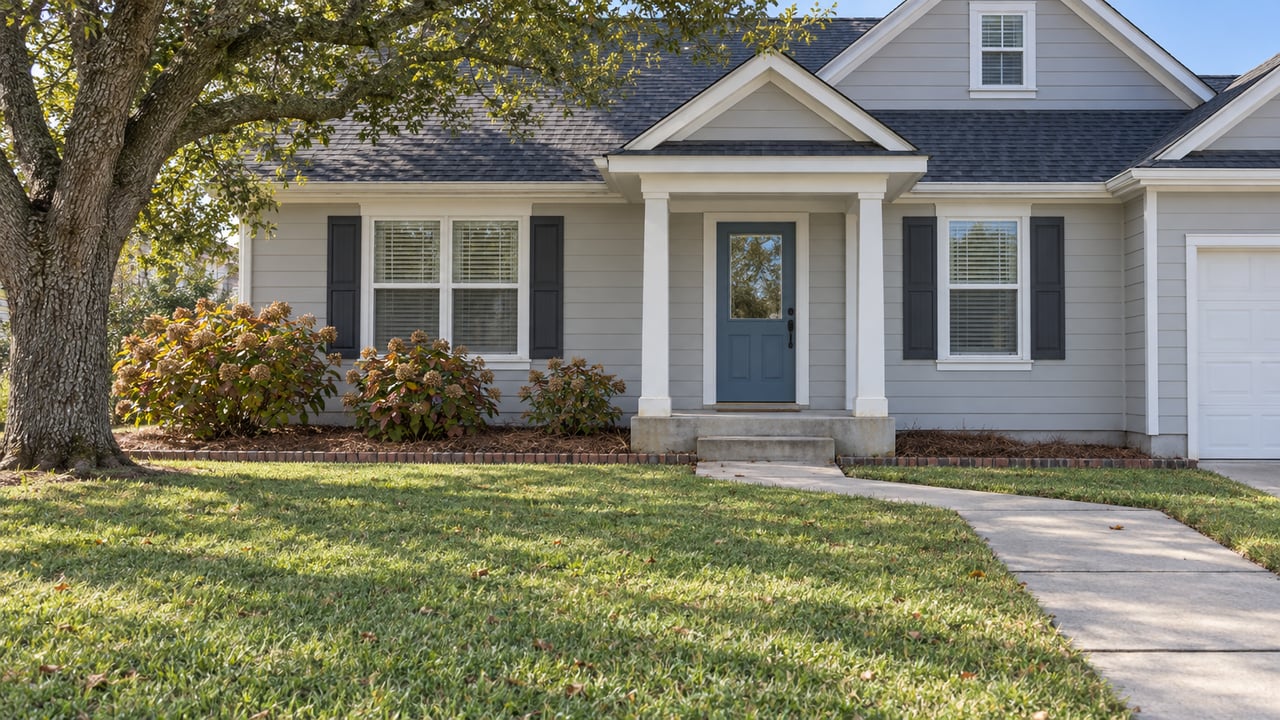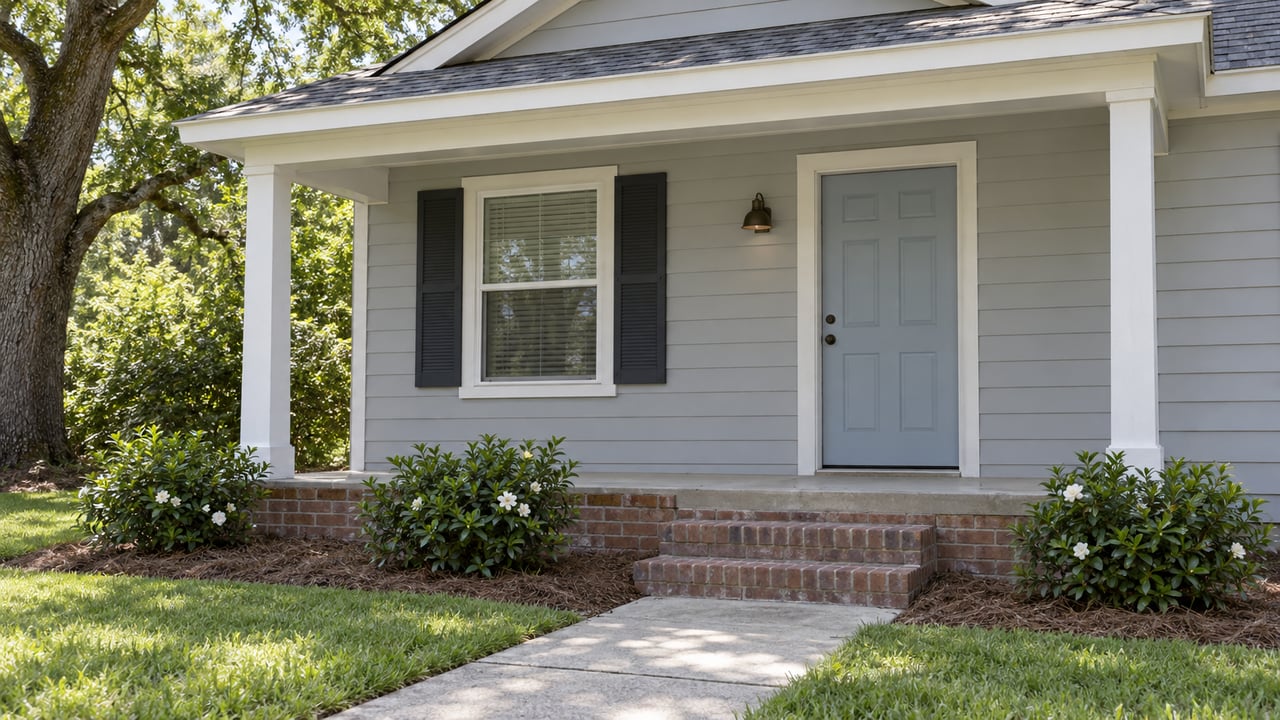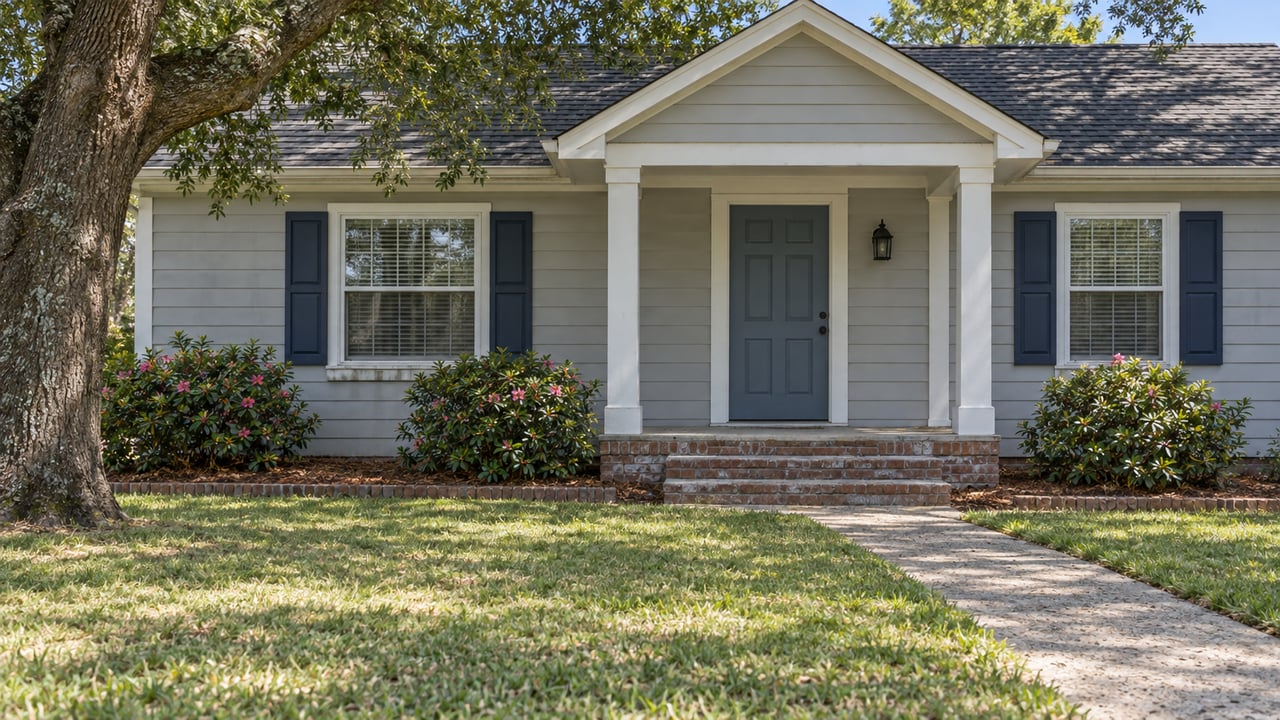
Picture two houses on the same Carolina Park street, built by the same builder in the same year and valued at the same number. In tax year 2026, one of them can carry a Charleston County property tax bill more than three times larger than the other's. The gap comes from one County application and the date on the deed.
That makes the "annual taxes" figure on a listing a weak guide to what a buyer will pay. It shows what the current owner pays under their own filing status, their own reassessment history and, on new construction, sometimes a builder exemption that ends at closing. None of those carry over to the buyer.
The same house at two assessment ratios
South Carolina taxes an owner-occupied legal residence on 4% of its taxable value. Everything else is taxed on 6%. In Charleston County the 4% ratio is never automatic: the owner has to apply and be approved, or the parcel stays at 6%.
On its own that would make a 6% bill 50% bigger than a 4% bill. The difference grows because of what the millage pays for. For the Town of Mount Pleasant, Tax District 21, the County Auditor's 2026 millage breakdown lists a total levy of 263.1 mills. Of those, 145.2 are school operating mills. Homes approved for the 4% ratio don't pay those 145.2 mills at all.
The table uses an illustrative taxable value of $700,000 to show the math. It is not a figure for any specific Carolina Park home, and it comes before the Local Option Sales Tax credit, which lowers the gross amount on a real bill.
| 6% ratio | 4% ratio | |
|---|---|---|
| Assessed value | $42,000 | $28,000 |
| Mills applied | 263.1 | 117.9 |
| Gross tax before LOST credit | about $11,050 | about $3,301 |
| Share of taxable value | about 1.58% | about 0.47% |
At a $1,000,000 taxable value, the same math gives about $15,786 at 6% and about $4,716 at 4%. In both cases the bill differs by more than $7,000 to $11,000 a year, depending only on the ratio.
Where the 117.9 mills come from
The exemption comes from state law. South Carolina Code Section 12-37-220 says that for property eligible for and receiving the owner-occupied ratio:
"one hundred percent of the fair market value of owner-occupied residential property eligible for and receiving the special assessment ratio ... is exempt from all property taxes imposed for school operating purposes but not including millage imposed for the repayment of general obligation debt."
So a 4% Carolina Park home still pays the 23.0 school bond mills. It also pays the 50.6 countywide mills for county government, parks and recreation, and Trident Tech, plus the Town's 44.3 mills, made up of 34.7 for operations and 9.6 for debt. Those add up to 117.9. The Auditor's 2026 millage card also lists a LOST credit factor of 0.00090 countywide and 0.00042 for Mount Pleasant.
The rates themselves look stable for now. Live 5 reported in June 2026 that Charleston County passed its budget without a county millage increase, and the Town of Mount Pleasant's August 31, 2026 Finance Committee minutes show the Town proposing to keep 44.3 mills, unchanged from the prior year. With rates holding steady, the assessment ratio is the biggest factor a buyer controls.
The seller's tax line ends at closing
A seller may have qualified for 4% years ago, so their listing shows the lower bill. That approval doesn't follow the house. Charleston County requires every new owner to file a fresh legal residence application.
The value under the bill changes too. The County treats a sale as an Assessable Transfer of Interest: a change in ownership, usually a sale or deed filing, that brings the property's valuation current between countywide reassessments. An ATI property is valued as of December 31 of the year it changed hands, and the 15% reassessment cap doesn't apply to it. The cap limits how much taxable value can rise from a reassessment. If the seller has owned through one or more capped reassessments, the value on their bill may sit well below where the buyer's value lands.
Closing math can hide all of this for a while. Charleston County real property taxes are paid in arrears and are due January 15 of the following year. The South Carolina Realtors Form 330, shown here in its 2017 version, has the closing attorney prorate taxes using available information deemed reliable. Buyer and seller then settle up later if the actual tax differs from the estimate. A proration based on the seller's capped, 4% figure is an estimate tied to a tax status the buyer doesn't have yet.
New construction can show almost no house on the roll
Homes bought directly from a builder add another layer. Since 2009, South Carolina has allowed builders to exempt a newly built, unsold, unoccupied detached single-family home from property tax. The exemption ends when the home is sold or occupied, or when it reaches the sixth December 31 after its certificate of occupancy. The builder applies by affidavit within 30 days of the certificate of occupancy and renews by January 31 in later years.
So a spec home can carry a tax history that covers mostly the lot. Once it sells, the exemption no longer applies. The County also notes that construction finished in the year before a reassessment is only partly capped. On a home's first sale, a small prior tax figure can reflect how long the builder held it rather than what the next owner will pay.
The calendar for anyone who bought in 2026
| Date | What happens |
|---|---|
| First week of October | Charleston County typically mails real property tax bills |
| January 15, 2027 | 2026 bills due without penalty; 4% applications typically due |
| After January 15 | 3% penalty |
| After February 1 | 10% total penalty |
| After March 17 | 15% total, bill sent to Delinquent Tax |
The County's application states that filing it does not delay payment of taxes already billed, and that penalties for late payment cannot be waived. The form's instructions say that if an application isn't approved by the time the bill is due, the owner pays the bill, and the County issues a refund if 4% is granted afterward. The Assessor's office says a new bill goes out when an application is approved, and it urges owners not to wait to file.
What the application asks for
The Legal Residence (4%) Application, revised April 14, 2026, asks the following of every owner-occupant and their spouse:
- A South Carolina driver's license or ID card showing the current address
- South Carolina vehicle registration showing the current address
- South Carolina voter registration showing the current address
- Federal and state income tax returns, with an example on the form of how to redact them
- Other documents where they apply, such as a divorce decree, trust documents, or a single-member LLC operating agreement
If anything is missing, the application won't be processed. A married applicant's spouse has to sign even if the spouse isn't on the title. The County accepts the form by mail or in person at 4050 Bridge View Drive in North Charleston, or through an online application. It does not accept fax or email. For relocating buyers, the license, registration and voter card are often the slowest pieces, because each one needs the new Carolina Park address on it first.
A few distinct questions
Does renting the home affect the 4% ratio?
The County's form says a residence rented more than 72 days in a calendar year doesn't qualify for that year. A home that was a vacation rental when purchased doesn't qualify for that year if the owner didn't move in within 90 days of buying it.
What if the prior owner had 4%?
That approval belonged to the prior owner. The new owner files their own application.
When is the next countywide reassessment?
Charleston County reassesses every five years and implemented its last countywide reassessment in 2025. On that cycle, the next one would fall around 2030.
This post is general information, not legal, tax or financial advice. Please confirm your own situation with the Charleston County Assessor's office at 843-958-4100 or with a qualified tax professional.
If you're weighing a Carolina Park home and want the tax line on the listing translated into what your bill might look like, Andrea Ulmer can go through the numbers with you before you write an offer. Request a free consultation, and we'll go over the listing's tax history together.